

Frequently Asked Questions About Valentino Bags
Almost all enquiries about Valentino bags trace back to a handful of facts that are surprisingly hard to find spelled out clearly. Much of what is passed around online is inaccurate, above all around authentication numbers and resale figures. A second company that carries part of the same name creates a confusion that keeps coming back. Everything below sticks to what can be checked, with anything that is only market practice marked clearly. Every price here is an observed 2026 market price seen on the brand’s own US site rather than an official price list. Even if pricing is all you came for, read the first four answers first, because those are the answers that head off the expensive mistakes.
Who founded the house, and does he still design its bags?
The house was founded in Rome in 1960, on Via Condotti, by Valentino Garavani with Giancarlo Giammetti. He sold out in 1998, walked away from design in 2007 with a final couture show in January 2008, and died on 19 January 2026 aged 93. So, no: he designed nothing current and he held no stake in the modern house. The house remains active, and Alessandro Michele has been creative director since 2024, having taken over from Pierpaolo Piccioli. Ownership lies with Mayhoola for Investments, which took 70 percent in 2012, and Kering, which took 30 percent in July 2023 and has said it intends to acquire the company fully by 2028. valentino bag Rome remains home to creative operations, while Milan holds the legal registration.
Is Mario Valentino part of Valentino?
No, and this is the most consequential thing to understand before buying. There is no connection between Valentino S.p.A., the couture house behind Valentino Garavani accessories, and Mario Valentino S.p.A.: they are entirely separate, unrelated businesses. Mario Valentino goes back to Naples in 1952, remains headquartered there, and specialises in leather goods and footwear rather than couture. It sells as “Valentino by Mario Valentino”, and its products are genuine, simply from a different company at a different price point. On its own account it has held the US trademark for handbags and leather goods since 26 April 1971, senior rights backed up in legal reporting. The two companies have litigated more than once, including a case filed in July 2019 that settled and was dismissed without prejudice on 14 June 2024, with terms undisclosed.
Why does my bag say GARAVANI?
Because a contract requires it. How each company uses the name is controlled by a 1979 coexistence agreement, which obliges Valentino S.p.A. to use “GARAVANI” alongside “VALENTINO” on leather goods and in advertising for them. The same agreement allows Mario Valentino to use “Mario Valentino”, “M. Valentino”, “Valentino”, “MV” or “V” outside, provided that “Mario Valentino” appears inside and on packaging, and it bars “V” and “Valentino” together on leather goods. So the word on your bag is a legal obligation, not a branding flourish. Within the house, “Valentino Garavani” labels accessories while “Valentino” and “Maison Valentino” label ready-to-wear, which is the same company and the same standards rather than a quality tier. A bag that reads only “Valentino” and carries “Mario Valentino” inside comes from the other company.
Do Valentino bags have date codes?
No, there is no such thing. There is no date-code system at Valentino of the kind some other houses use, and it is a persistent source of bad advice. What exists is a serial number, typically on a tag inside an interior pocket, the tag often black, cream or light brown. It is not universal, though: older models may carry none, and a missing serial is not by itself proof of a fake. So a seller offering to decode a date code is inventing, and the claim should be treated as a warning sign. An authenticity card reportedly carries model spec, serial and Made in Italy, but that description comes from resale guides rather than the house, and many pre-owned bags arrive without one.
How do I spot a fake?
The first question is which company made it, not whether it is real, because a genuine Mario Valentino bag fails a Garavani checklist and is nonetheless entirely authentic. Once that is settled, go through the physical details. The interior tag should read VALENTINO and GARAVANI in capitals with MADE IN ITALY, sewn on all four sides, the font weight consistent and the stamping unsmudged. Hardware logos are engraved rather than printed, zip pulls are square with rounded edges and deep engraving, and studs are uniform pyramids, evenly spaced and firmly set. Stitching should be even, aligned and consistent in density. Two claims can be ignored, that a date code proves anything and that a red lining proves authenticity, because neither is verified and provenance remains the real safeguard.
How much do Valentino bags cost in 2026?
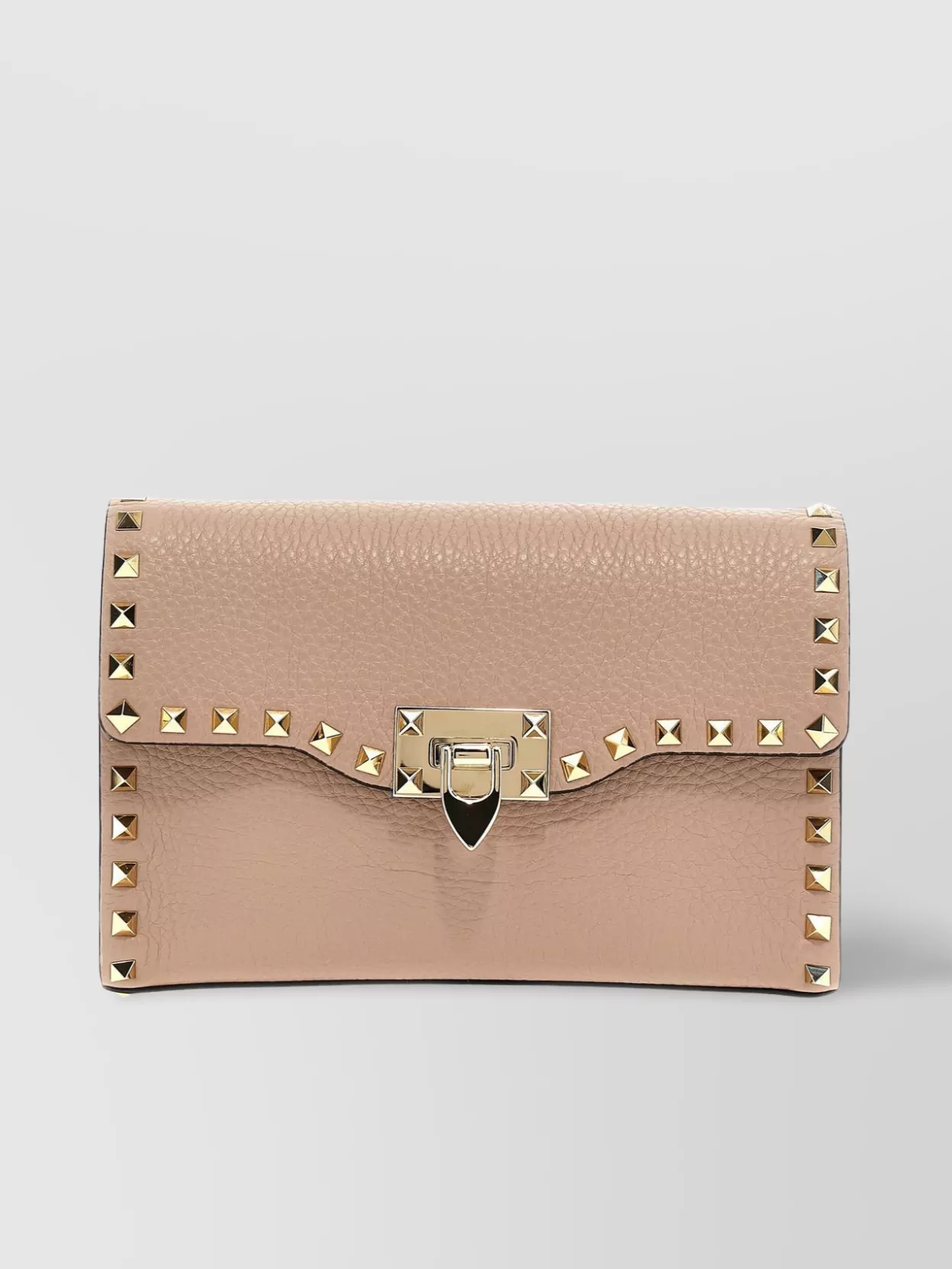
Across current lines the observed range runs from $650 to about $7,900, and the spread within a single line is often wider than the gap between lines. Entry starts at roughly $650 to $1,500: VLogo Signature clutches, Rockstud wallets and the Rockstud mini shopping bag. The commercial core runs about $1,650 to $3,600 and covers most Rockstud, Rockstud Spike, Locò, VSling and VLogo shopping pieces. The top band, roughly $3,700 to $7,900, is made up of embroidery, crystal and pearl work and exotic skins. Most of the variation is driven by material: the same Rockstud mini shopping bag is $1,390 in grainy calfskin and $1,850 in pony-effect. The table below sets out the observed range for each major current line.
| Line | Range observed | Usual entry piece |
|---|---|---|
| VLogo Signature | $650 to $3,750 | Grainy calfskin clutch, $650 |
| Rockstud | $1,250 to $2,100 | Mini shopping bag, $1,390 |
| DeVain | $2,100 to $3,900 | Shoulder in jacquard lurex, $2,100 |
| Rockstud Spike | $2,400 to $3,700 | Crossbody clutch, $2,400 |
| Locò | $2,700 to $5,900 | Small, in calfskin, $2,700 |
| VSling | $3,350 to $6,550 | Small, in grainy calfskin, $3,350 |
| Panthea | $3,800 to $7,900 | Nappa and suede chevron, $3,800 |
Do Valentino bags retain value on resale?
Moderately, and far less than the eighty percent figure that gets repeated online, which no verified data supports. Resale analysis places Valentino handbags at roughly 41 percent retention across the house. Individually, the strongest styles arrive between 50 and 58 percent. Among the recorded examples are the Roman Stud Flap at 58 percent, the VLogo Locò Flap Shoulder at 57, the Rockstud Drawstring Bucket and Rockstud Flip Lock Flap at 56, and the Rockstud Pouch Crossbody at 50. In practice, a medium Rockstud Spike has been noted near $1,700 against roughly $2,900 new. Recognisable motif bags hold best, which puts the house in mid-tier territory, and none of this is investment advice.
Where should I buy, and is there a real sale?
Buy from the house’s own webstore or its boutiques, or from retailers verified as carrying the line: Neiman Marcus, Bergdorf Goodman, Saks Fifth Avenue, Nordstrom, Mytheresa, Net-a-Porter, Farfetch, Selfridges, Harrods, Giglio and Tessabit. There is such a thing as a real Valentino bag sale, as the house runs official seasonal sales on its own site, though as of September 2026 the US sale page said the Spring/Summer 2026 sale had ended. The page structure points to private sales, which suggests a newsletter-gated mechanic rather than a permanently open discount store. THE OUTNET, the off-price arm of Net-a-Porter, does carry Valentino Garavani, although how deep its discounts run is not established. The Mall Firenze in Leccio Reggello, Tuscany, has an outlet boutique, and a store is reported at Fidenza Village. Be sceptical of any site that strings together the brand name with words like outlet or sale and offers deep permanent discounts on current-season stock.
Are off-price chain Valentino bags genuine?
Authentic, yes, but not what most shoppers imagine they are buying. What Nordstrom Rack, Saks OFF 5TH and TJ Maxx carry is “Valentino by Mario Valentino”, confirmed through their own brand-filter pages. Those bags come from Mario Valentino S.p.A., the separate Naples company, not the couture house. So the bag is authentic and the retailer is legitimate, and it is still not a Valentino Garavani bag. It will not carry GARAVANI on the interior tag, it sits at a different price point, and it will not behave like a Garavani piece on resale. Do not assume any US off-price chain is discounting genuine Garavani stock, and read the label before the price tag.
Which bag works for everyday use, and how should it be cared for?
For everyday carrying, the most defensible choice is grainy calfskin in a recognisable silhouette: the Rockstud mini shopping bag at $1,390 if you want a Valentino tote bag, the small Rockstud crossbody at $1,650 if you want a Valentino crossbody bag, or the Rockstud small shoulder at $2,100 for a Valentino shoulder bag. Grainy calfskin keeps its shape, resists scuffing and hides fingerprints, and it is usually the cheapest material in its line. What follows is general luxury-leather practice, not official instruction: wipe nappa and calfskin with a soft dry cloth, use a nappa cream, blot stains, and air dry rather than heat. Suede and kidskin call for a dry brush and a protector spray, kept away from water and oils. On laminated, metallic and mesh pieces the finish fails before the leather, and python and ostrich need professional care and no direct sun. Never polish plated antique-brass or light-gold hardware, and store the bag in its dust bag, lightly stuffed, cool, dry and uncompressed.